Joe Christensen

Software and results.

Research software I have built and results I have achieved, each with the place to check it.

Competition · MICCAI 2026 · 1 October

First place in the 4D Flow MRI challenge

4D Flow MRI films blood moving through the vessels. The challenge was to rebuild each scan from its raw data as fast as possible on one fixed GPU, while matching the accuracy of the organisers' reference network.

My entry took 3.31 seconds per scan, three times faster than the next team. Fourteen teams reached the final; I entered on my own.

Check it
The organisers' official final ranking of CMRx4DFlow2026, released at MICCAI in Strasbourg on 1 October 2026, timed on 27 hidden test scans. My entry is listed as Team J6.
Seconds per scan, official final ranking · lower is faster

1. Aarhus University (solo)3.31 s
2. Team based in Beijing10.31 s
3. UCLA11.45 s
4. Leibniz University Hannover24.98 s
5. Hangzhou Institute for Advanced Study26.41 s

The top five of the reconstruction-speed task, with each team's institution. Every entry had to match the reference network's accuracy; ranking is then by speed alone.

Research software · nine open-source tools

SwiftX

Standard bioinformatics tools, rebuilt to run tens to thousands of times faster. Each is a drop-in replacement that gives the same results as the tool it replaces; eight of them write its output byte for byte.

Check it
Every tool's code is public with a two-command reproduction of its benchmark. SwiftLD and SwiftNJ are preprints on bioRxiv; the other seven manuscripts are drafts.
ToolReplacesTimes fasterOutput checked
SwiftSNPsnp-dists
2,894×
188,700 random tests, 67 real-data runs
SwiftLDvcftools, LD
826×
167,749 differential tests
SwiftRelvcftools, relatedness
470×
52,900 random tests
SwiftPhylipvcf2phylip
221×
Random and real data, every deterministic option
SwiftDistSeqsmothur dist.seqs
54 to 92×
430 random inputs, every output option
SwiftSitessnp-sites
43×
78,000 random tests, 3,015 edge cases
SwiftTN93tn93
25 to 30×
33,300 random tests, 13,948 further cases
SwiftCovbedtools coverage
13 to 34×
22,200 generated test cases
SwiftNJRapidNJ
1.77×
Same trees as the reference on 400 shuffled inputs

Each speed-up is the headline of that tool's manuscript, against the tool it replaces. For every tool but SwiftNJ, no byte of output differed in the tests listed. Bar length is logarithmic, from 1× at the left; a range is drawn solid to its low end and pale to its high end.

Preprint · bioRxiv · 5 November 2026

SwiftLD

SwiftLD computes linkage disequilibrium, how strongly nearby genetic variants are inherited together, and writes the same file as vcftools, byte for byte.

826×

faster than vcftools on an AVX-512 processor, and about 102 times faster on an ordinary laptop.

Check it
No byte of output differed from vcftools in 167,749 differential tests on three machines. Code and a two-command reproduction are public.
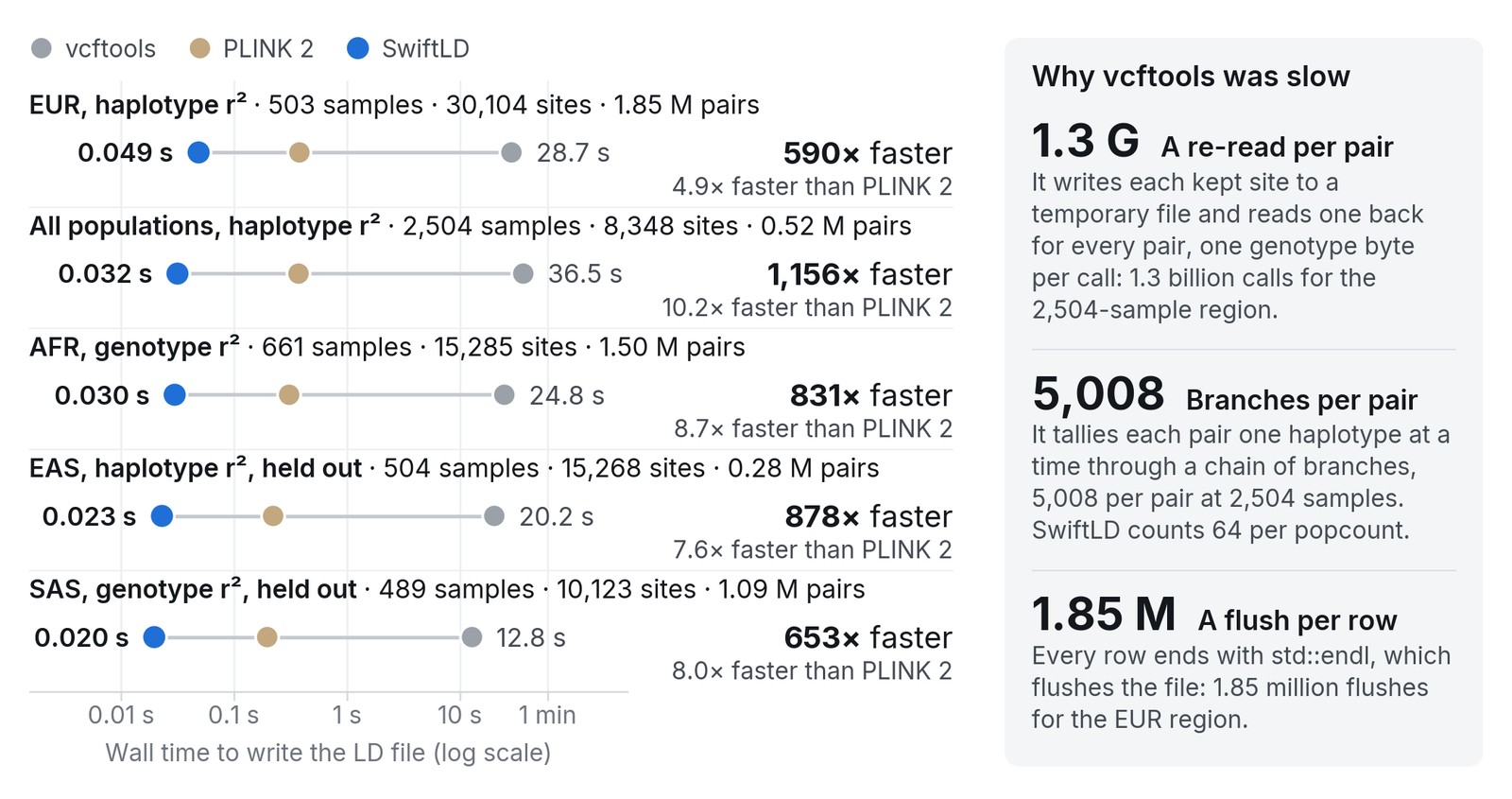
Figure 1 of the SwiftLD preprint. On five regions of 1000 Genomes chromosome 22, SwiftLD writes the LD file in 0.020 to 0.049 seconds, where vcftools takes 12.8 to 36.5 seconds: 590 to 1,156 times faster, and 4.9 to 10.2 times faster than PLINK 2. A side panel lists why vcftools was slow: a re-read per pair, branches per pair, a flush per row.
Figure 1 of the preprint. Time to write the LD file on five regions of 1000 Genomes chromosome 22, log scale; the bottom two regions were held out while the tool was built. Right: why vcftools was slow.

Preprint · bioRxiv · 29 May 2026

SwiftNJ

Exact neighbour joining, the method behind many family trees of viruses and bacteria, made faster than RapidNJ, a tool already tuned by hand.

Check it
On 400 shuffled inputs, every tree matched the QuickTree reference exactly (Robinson-Foulds distance zero).
1.77×

faster than RapidNJ across 59 test matrices, and faster on 58 of them.